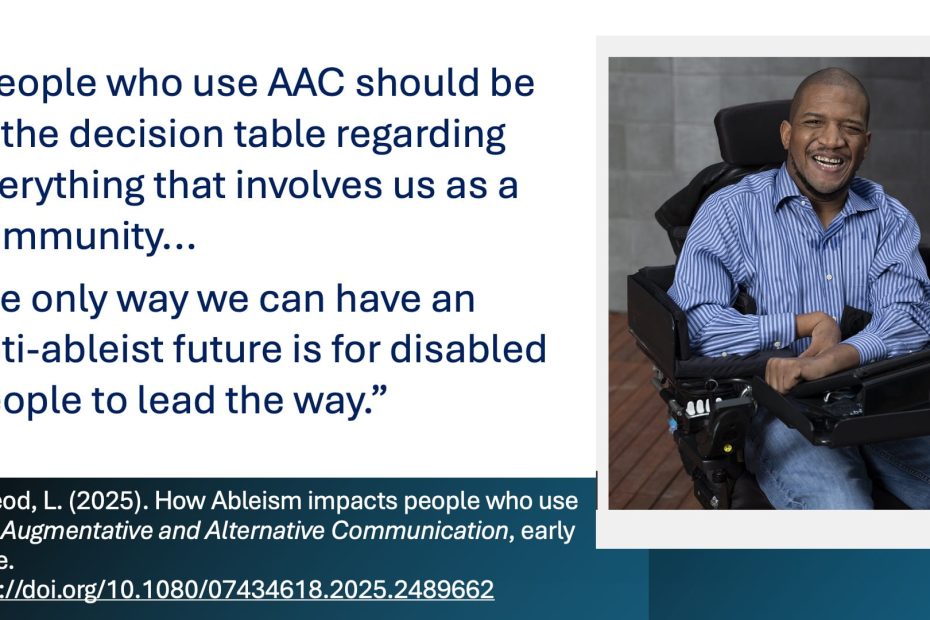
How Ableism impacts people who use AAC (McLeod, 2024)
Dr. Lateef McLeod describes the impact of Ableism on people who use AAC.
Dr. Lateef McLeod describes the impact of Ableism on people who use AAC.
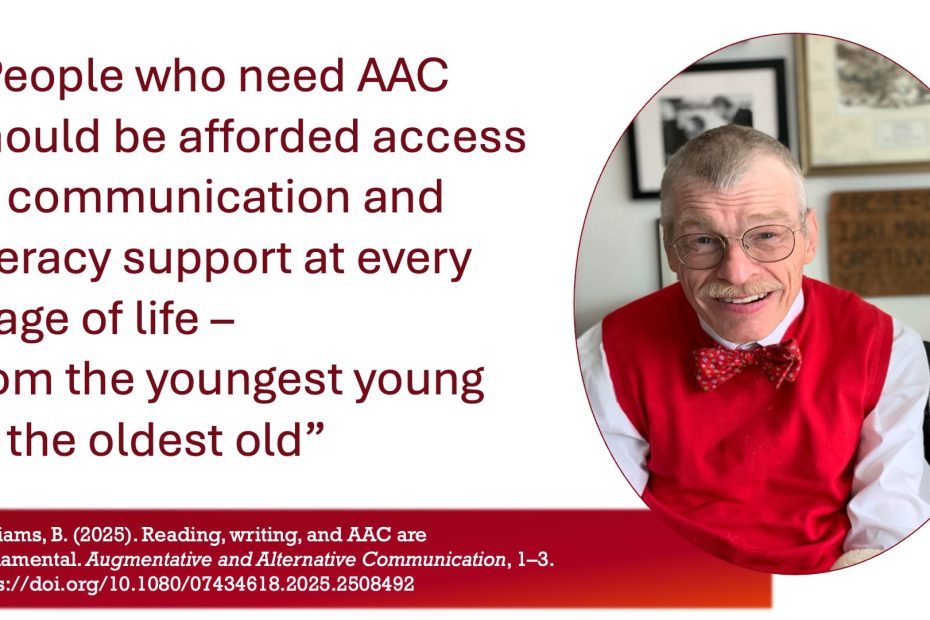
Bob Williams describes barriers to literacy for people who need and use AAC.
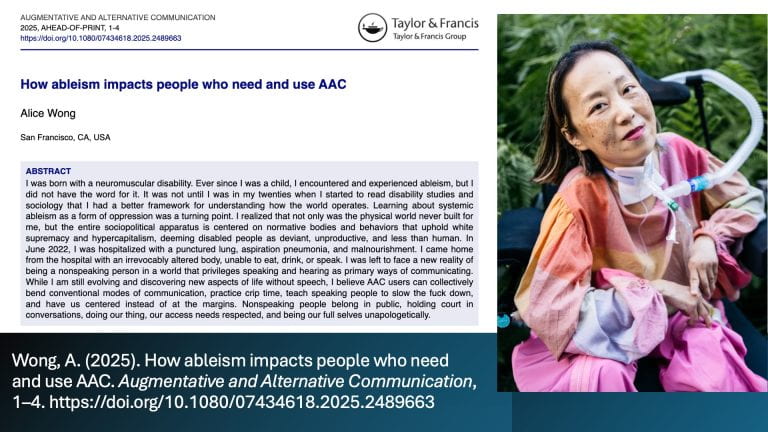
Alice Wong Alice Wong (she/her) was a disabled activist, writer, media maker, and consultant, and lived from 1974 to 2025. Alice was the founder and director of the Disability Visibility Project, an online community dedicated to…
The INSTRUCT app was developed and evaluated under grant 90REGE0014 to the RERC on AAC (2020-2025) from NIDILRR. The following publications and presentations describe research projects that evaluated the use of the INSTRUCT app Exton,…
Registration for the AAC Learning Center Moodle is a 3-step process. At the home page for the AAC Learning Center Moodle, select the option to register a new account. 2) On the Registration…

Anthony Arnold describes his use of AAC to pursue 4 key goals of adult life
This page contains links to content discussed in Goldman, A., Jackson, D., Kannan, K., Canter, C., Klein, C., Marshall, S., McNaughton, D., Paul, D., Rackensperger, T., Soto, G., Zangari, C. (2021). Training needs in augmentative…
Creative uses of a visual scene display (VSD) approach to supporting communication
This series of webcasts of webcasts provides information on strategies to improve patient-provider communication for persons with complex communication needs. This series includes presentations by Sarah Blackstone (introduction) Amy Wilson Stronks Richard Hurtig Paul Rao…
Free ePrint available
The iPad and other mobile technologies provide powerful new tools to potentially enhance communication for individuals with developmental disabilities, acquired neurogenic disorders, and degenerative neurological conditions. These mobile technologies offer a number of potential benefits, including: (a) increased awareness and social acceptance of augmentative and alternative communication (AAC), (b) greater consumer empowerment in accessing AAC solutions, (c) increased adoption of AAC technologies, (d) greater functionality and interconnectivity, and (e) greater diffusion of AAC research and development. However, there remain a number of significant challenges that must be addressed if these benefits are to be fully realized…
Free ePrint available
Light and McNaughton apply the framework proposed by the International Classification of Functioning, Disability and Health (ICF) to illustrate the need to re-think AAC intervention to improve outcomes for individuals with complex communication needs, and to foster a new generation of intervention research that will provide a solid foundation for improved services. Specifically, the paper emphasizes the need to take a more holistic view of communication intervention and highlights the following key principles to guide AAC intervention and research: (a) build on the individual’s strengths and focus on the integration of skills to maximize communication, (b) focus on the individual’s participation in real-world contexts, (c) address psychosocial factors as well as skills, and (d) attend to extrinsic environmental factors as well as intrinsic factors related to the individual who requires AAC.
Free ePrint available
In the 25 years since the definition of communicative competence for individuals who use AAC was originally proposed, there have been significant changes in the AAC field. In this paper, Light and McNaughton review the preliminary definition of communicative competence, consider the changes in the field, and then revisit the proposed definition to determine if it is still relevant and valid for this new era of communication.
In a recent podcast for Speech Uncensored, Dr. Susan Fager discussed her research on access and communication technology
Dr Janice Light describes the use of AAC to build language skills with children (webcast).
Drs. Janice Light and David McNaughton describe effective evidence-based practices to maximize the literacy skills of individuals who require AAC (webcast)